
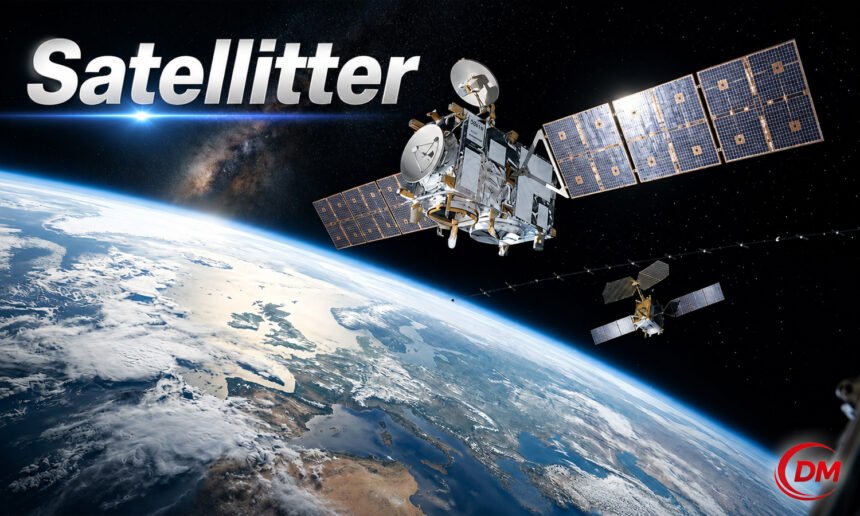
Have you ever looked up at the night sky and wondered what those tiny moving lights are? Many of them are satellites. Today, satellites are a big part of our daily life. They help us get directions on our phone, watch TV, check the weather, and even make phone calls. But what exactly is a satellite, and how does it work?
What Is a Satellite?
A satellite is any object that moves around a larger object in space. There are two types of satellites: natural satellites and man-made satellites.
The Moon is a natural satellite. It moves around the Earth. Just like that, Earth also moves around the Sun, so in a way, Earth is a natural satellite of the Sun.
Man-made satellites are machines that humans build and send into space. Once they are up there, they orbit (travel around) the Earth. These machines collect information, send signals, and do many important jobs that help us here on the ground.
The first man-made satellite was called Sputnik 1. It was launched by the Soviet Union on October 4, 1957. It was a small metal ball with antennas, and it went around the Earth every 96 minutes. This moment changed history and started the age of space technology.
How Do Satellites Stay Up in Space?
This is a question many people ask. If you throw a ball, it falls down. So why does a satellite not fall?
The answer is speed and gravity working together.
When a satellite is launched, it travels at a very high speed, usually around 28,000 kilometers per hour (about 17,500 miles per hour). At this speed, as the satellite falls toward Earth due to gravity, the Earth’s surface curves away beneath it. So the satellite keeps falling but never actually hits the ground. It keeps going around and around the Earth. This is called being in orbit.
Think of it like swinging a ball on a string. If you swing it fast enough, it stays out. If you slow down, it falls. Satellites work in a similar way, except there is no string. Gravity is what keeps them connected to Earth.
Different Types of Satellites
Not all satellites are the same. They are placed at different heights and serve different purposes. Here are the main types:
Low Earth Orbit (LEO) Satellites
These satellites travel between 160 and 2,000 kilometers above Earth. They move very fast and complete one full orbit in about 90 minutes. Because they are so close to Earth, they can collect very detailed images and data.
Examples include the International Space Station (ISS) and many weather satellites. The SpaceX Starlink satellites are also in LEO. They provide fast internet to people in remote areas.
Medium Earth Orbit (MEO) Satellites
These satellites are placed between 2,000 and 35,786 kilometers above Earth. GPS satellites are a good example of MEO satellites. They help your phone know exactly where you are.
Geostationary Orbit (GEO) Satellites
These are placed about 35,786 kilometers above the equator. At this height, a satellite takes exactly 24 hours to go around Earth, which is the same time Earth takes to rotate once. This means the satellite always stays above the same spot on Earth.
Television broadcast satellites use this orbit. That is why your TV dish always points in the same direction.
Polar Orbit Satellites
These satellites travel from pole to pole (from north to south). As Earth rotates below them, they can cover the entire surface of the planet. They are great for mapping, environmental monitoring, and weather forecasting.
READ MORE Investiit.com Tips Explained: Simple Investment Advice for Beginners to Start Smart Investing
What Are Satellites Used For?
Satellites do a lot of important work. Here are the main things they help us with:
1. Communication
Satellites help us make phone calls, send text messages, and use the internet, especially in places where there are no cables or towers. Submarine cables on the ocean floor also help, but satellites are important for reaching remote islands, mountains, and rural areas.
2. Navigation (GPS)
When you use Google Maps or any navigation app, you are using GPS, which stands for Global Positioning System. GPS is a network of satellites that help your device figure out exactly where you are on Earth. Without GPS satellites, navigation apps would not work.
3. Weather Forecasting
Satellites watch Earth’s atmosphere from above. They can see clouds, storms, hurricanes, and temperature changes. This data helps meteorologists (weather scientists) make forecasts and warn people about dangerous weather like floods or cyclones before they happen.
4. Earth Observation
Satellites take photos and collect data about the Earth’s surface. Scientists use this information to study deforestation, melting ice in the Arctic, changes in ocean levels, urban growth, and much more. This helps governments and organizations make better decisions about the environment.
5. Military and Defense
Many countries use satellites for national security. They monitor borders, track movements, and gather intelligence. Military satellites also help soldiers communicate in the field.
6. Science and Research
Satellites like the Hubble Space Telescope have given us stunning images of distant galaxies. Scientific satellites study the sun, cosmic radiation, black holes, and other space phenomena that we cannot observe from the ground.
7. Disaster Management
After a natural disaster like an earthquake or flood, satellites can quickly map the affected area and help relief teams understand where help is needed most. This saves lives.
How Is a Satellite Made and Launched?
Building a satellite is a complex process. It takes years of planning, designing, and testing. Here is a simplified version of how it works:
Design: Engineers decide what the satellite will do and plan every part of it.
Building: Technicians build the satellite in a very clean room to avoid any dust or particles that could damage it. The satellite is made of strong but light materials.
Testing: The satellite is tested in conditions similar to space, including extreme cold and heat, vibrations, and vacuum (no air).
Launch: The satellite is placed on top of a rocket. The rocket blasts off and carries the satellite into space. Once it reaches the right orbit, the satellite separates from the rocket and starts its job.
Most rockets burn up or fall back to Earth after launch. Some companies, like SpaceX, have developed rockets that can land back on Earth and be used again. This has made launching satellites much cheaper.
How Long Do Satellites Last?
The lifespan of a satellite depends on its type and purpose. Most communication and weather satellites last between 10 and 15 years. Scientific satellites may last longer. The Hubble Space Telescope was launched in 1990 and is still working today.
Over time, satellites use up the fuel needed to keep them in the correct orbit. When the fuel runs out, the satellite can no longer be controlled. Small satellites in low orbit will slowly fall back to Earth and burn up in the atmosphere. Larger satellites in higher orbits may stay up there for hundreds or even thousands of years.
Space Junk: A Growing Problem
As more satellites are launched, a big problem is growing in space: space junk. This includes old satellites, broken parts, and pieces of rockets that are still floating around Earth.
Right now, there are thousands of pieces of debris in orbit. Even a small piece moving at high speed can damage or destroy a working satellite. Scientists and space agencies are working on solutions to track this debris and find ways to clean it up. Some ideas include using robotic arms, nets, and even lasers to remove the junk.
The Future of Satellites
The satellite industry is growing fast. Companies like SpaceX, Amazon, and OneWeb are launching thousands of small satellites to build global internet networks. This means people in even the most remote parts of the world will soon have access to fast internet.
Smaller and cheaper satellites called CubeSats are also becoming popular. Universities and small companies can now build and launch satellites at a much lower cost. This opens up space to more countries and organizations.
There is also talk of using satellites to help with space tourism, asteroid mining, and even building space stations in the future.
Interesting Facts About Satellites
- There are more than 7,000 active satellites currently orbiting Earth.
- The GPS system has at least 24 satellites active at all times, so your location can always be found anywhere on Earth.
- A satellite traveling in LEO moves so fast that it circles Earth about 16 times per day.
- The Hubble Space Telescope has traveled more than 7 billion kilometers since its launch in 1990.
- Some satellites are as small as a shoebox, while others are as big as a school bus.
Final Thoughts
Satellites have changed the way we live. From getting directions on your phone to watching live TV from across the world, satellites are quietly working above us every single day. They help us communicate, stay safe, understand our planet, and explore the universe.
As technology gets better and cheaper, satellites will become even more important. More countries, companies, and even schools will have access to space. The sky is truly no longer the limit.
Next time you use your phone’s map or check the weather, remember there is a machine flying hundreds of kilometers above you, making it all possible.Share
10 Frequently Asked Questions (FAQs)
1. What is the difference between a natural satellite and a man-made satellite? A natural satellite is an object in space that orbits a planet naturally, like the Moon orbiting Earth. A man-made satellite is a machine built by humans and sent into space to do specific jobs like communication, navigation, or weather forecasting.
2. How many satellites are in space right now? As of recent estimates, there are over 7,000 active satellites in orbit. There are also thousands of old or broken satellites and pieces of debris floating in space.
3. Can satellites fall back to Earth? Yes, satellites in low orbit slowly lose altitude and eventually fall back to Earth. Most of them burn up completely in the atmosphere before reaching the ground. Larger pieces may survive and land, but this is very rare and agencies track them closely.
4. Who owns satellites? Satellites are owned by governments, space agencies, private companies, and sometimes universities. Countries like the USA, Russia, China, India, and many others have their own satellite programs. Private companies like SpaceX, Amazon, and SES also own large numbers of satellites.
5. How does GPS work using satellites? Your GPS device receives signals from at least four satellites at the same time. By calculating how long each signal took to arrive, the device can figure out exactly where you are on Earth. This process is called trilateration.
6. Why are some satellites in geostationary orbit? Satellites in geostationary orbit stay above the same point on Earth because they orbit at the same speed Earth rotates. This makes them perfect for TV broadcasts and some communication services because you do not need to move your antenna to track them.
7. Can we see satellites from Earth? Yes, you can see satellites with the naked eye, especially just after sunset or before sunrise when the sky is dark but the satellite is still lit by the sun. They look like a slow-moving star. Apps like Stellarium or Heavens-Above can tell you when and where to look.
8. What happens when a satellite runs out of fuel? When a satellite runs out of fuel, it can no longer be steered or kept in the right orbit. Small satellites in low orbit will gradually fall and burn up. Larger satellites in high orbit are usually moved to a “graveyard orbit” farther away from Earth to avoid collisions.
9. What is a CubeSat? A CubeSat is a very small satellite, usually about the size of a shoebox. They are cheaper to build and launch than traditional satellites. Universities, small companies, and developing countries use CubeSats for research and experiments.
10. Is satellite internet better than regular internet? Satellite internet is very useful in remote areas where there are no cables or towers. However, it can be slower and have more delay than fiber or cable internet. New satellite internet services like Starlink are improving speed and reliability, making satellite internet a good option for many people.
See more amazing Information, Dupper Magazine