
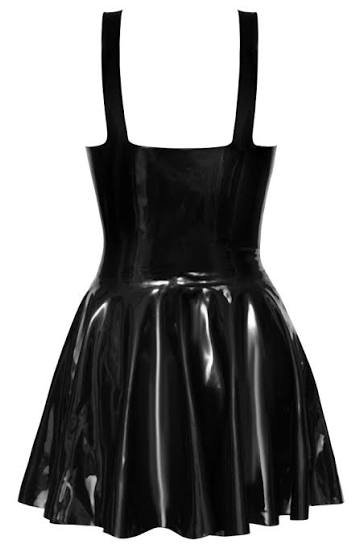
It is easy to make a latex wishlist more complicated than it needs to be. A dramatic catsuit, a sculpted corset, an elaborate hood: each has its appeal. Beside them, a straightforward black mini dress can look almost too simple to deserve much thought.
Then comes the practical question: which piece can you picture wearing in more than one way? Sometimes a low scoop neckline, a sleeveless shape and a centre-front zip offer enough interest without asking the whole outfit to revolve around a complicated design.
That is the appeal of this combination: a close-fitting black latex mini with separate opera-length gloves. The dress supplies the outline. The gloves change the mood. Neither needs much else.
A simple shape leaves the details exposed
On an understated dress, there is less to distract from the neckline, the zip line and the fit through the torso. That is not a drawback. It is a reason to pay attention to those details before choosing a size.
A scoop neckline frames the upper body differently from a high collar. A sleeveless cut leaves the shoulders and arms visible, while the centre-front zip gives the dress a clear vertical line. With no elaborate panels or accessories competing for attention, the proportions become the design.
Black also leaves room to vary the styling without changing the garment. Bare arms and minimal accessories give a different impression from long gloves and more deliberate jewellery. The same silhouette can be the starting point for a small gathering or a planned photoshoot, without needing to look identical in both settings.
What 0.40 mm tells you, and what it does not
The version described here uses 0.40 mm black latex. Thickness is a useful specification, but it is not a complete description of fit, comfort or quality. Pattern, measurements and construction matter too.
It would be misleading to promise that a particular thickness will never feel restrictive, or that it guarantees a certain lifespan. A well-chosen thickness cannot compensate for a torso that is too short or a neckline that sits in the wrong place.
If you already own latex dress, your existing pieces can be useful references. Consider what you like about their fit and what you would change. Keep those observations separate from body measurements: an older garment’s dimensions are not a substitute for measuring yourself.
A front zip is useful, but it still needs care
A centre-front opening gives access from the front rather than requiring you to reach behind your back. Whether that makes dressing easier for you depends on the fit and the opening’s construction, but it is a practical detail worth considering.
The zip area is also worth inspecting when the dress arrives. Look at how the latex lies beside it and whether the edges sit evenly. Appearance alone cannot prove seam strength, so do not treat a tidy finish as a promise that the garment can tolerate force.
When dressing, keep latex and skin clear of the slider and close the zip gently. If it catches or resists, stop and check what is in the way rather than pulling harder. A zip should not be used to haul a too-small garment into place.
Separate gloves, two distinct looks
Opera-length gloves make a useful styling choice precisely because they are separate. Wear the dress without them for a cleaner sleeveless outline, or add them when you want the arms to become part of the look.
This is different from choosing an integrated long-sleeve design. Separate gloves have their own fit requirements through the hands and arms, and their position can change as you move. They are not simply a sleeve extension that will suit everyone automatically.
If you are ordering a similar combination, check whether gloves are included, optional or sold separately. A styled photograph does not always describe what comes with the dress.
Close-fitting should not mean choosing the smallest size
A mini dress brings several fit questions together. The chest, waist and hips need to work with the length of the torso, while the hem needs to sit where you expect it to. Matching one circumference does not settle the rest.
Before deciding on a standard size, compare your actual body measurements with the size chart. Use a soft tape against your body, keeping it snug without pulling it tight. Do not subtract from your measurements to account for latex stretch.
If your measurements fall across several sizes, made-to-measure sizing is worth considering. It lets the maker assess your proportions rather than enlarging or reducing the whole dress to accommodate one area. It is not a reason to skip careful measuring: the result still depends on accurate information and clear agreement about the design.
You can find our measuring guidance and submit your details through our customisation page.
Give the first try-on a little time
A first fitting is more useful when it is not rushed five minutes before leaving home. Follow the garment’s dressing and care instructions, and take time to check the neckline, armholes, zip and hem.
Stand, sit and move gently to assess the fit. Notice whether a seam is under uncomfortable tension or the dress shifts in a way you did not expect. Do not assume discomfort is something you must simply get used to. If something seems wrong, stop and ask the maker for advice before continuing to wear it.
For a polished finish, follow the care guidance for a latex-compatible shine product. There is no need to promise that one application will last an entire evening: appearance depends on the product, handling and wear. Avoid snagging jewellery and rough surfaces, and never assume that neat seams make latex immune to damage.
The strongest argument for a simple black latex mini dress is not that it does everything. It is that a few considered choices can be enough: a neckline you like, proportions that suit you, a practical opening and the option to change the look with separate gloves.
A quieter design still deserves careful construction and a thoughtful fit. Simple does not have to mean an afterthought.